
Tamilnadu Election Analysis
The Delta is in the Delta

Background
I explored Tamil Nadu’s electoral history, demographics and political divisions in part 1 of this series. In this last part, I will look at the alliances in the fray and present my projections for the state.
Alliances
The current election is being contested by 4 main fronts/parties.
Secular Progressive Alliance
This is the front headed by the DMK in Tamil Nadu. The table below lists the parties in the alliance along with their 2021 vote share %.
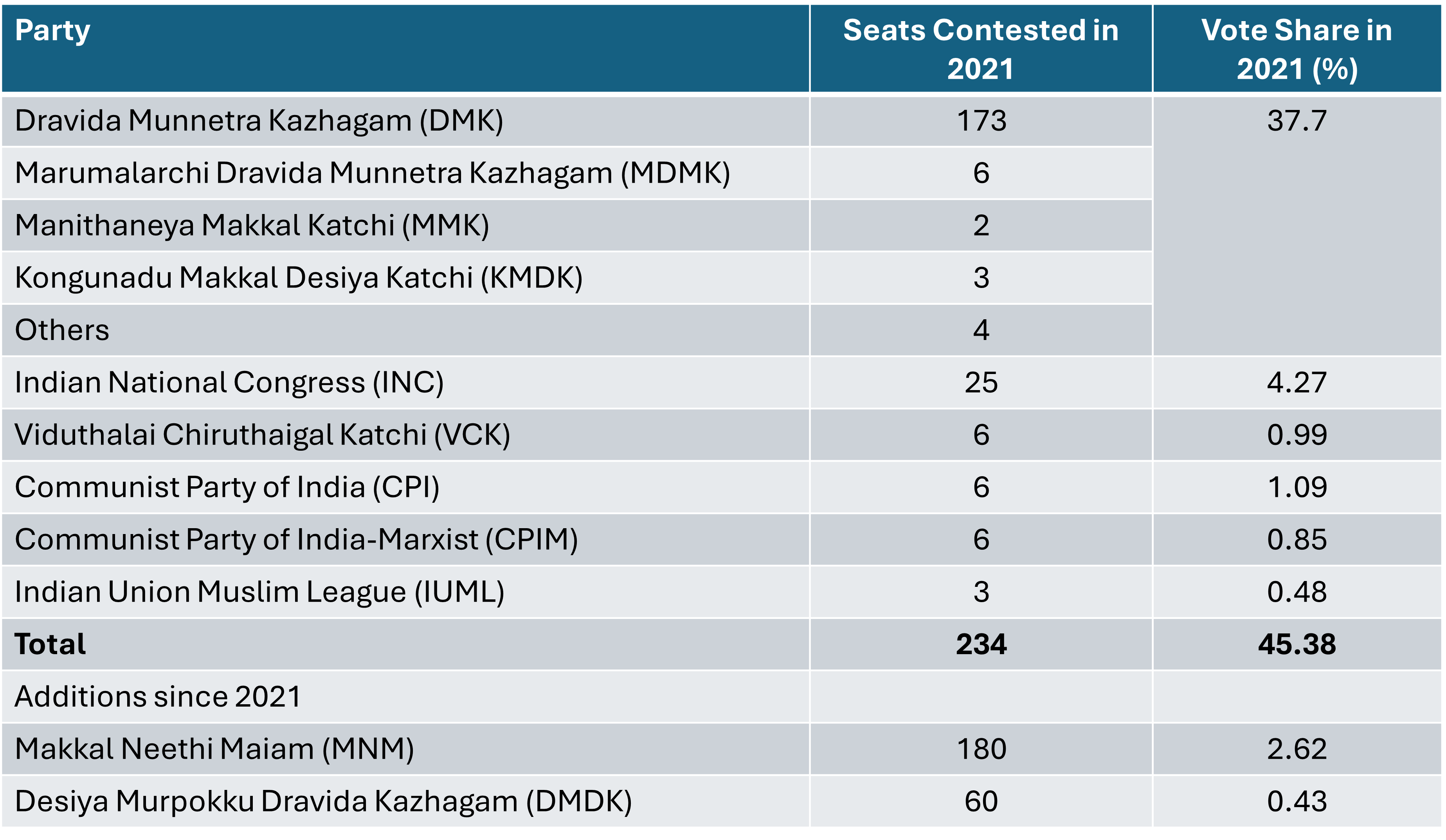
Note: The parties in first 5 rows all contested on the DMK symbol in 2021. Others include 4 small parties (Tamizhaga Vazhvurimai Katchi, Makkal Viduthalai Katchi, Forward Bloc, Aathi Tamizhar Peravai) who contested 1 seat each.
Of all the alliance partners, the INC-DMK is the most significant. As the linked article illustrates, the 2 parties have complemented each other and mutually benefited in the 8 elections contested together. Despite persistent reports of fissures in their alliance, I believe that the INC and DMK will work together in the upcoming election.
National Democratic Alliance (NDA)
The parties in their alliance with their vote shares is shown below:
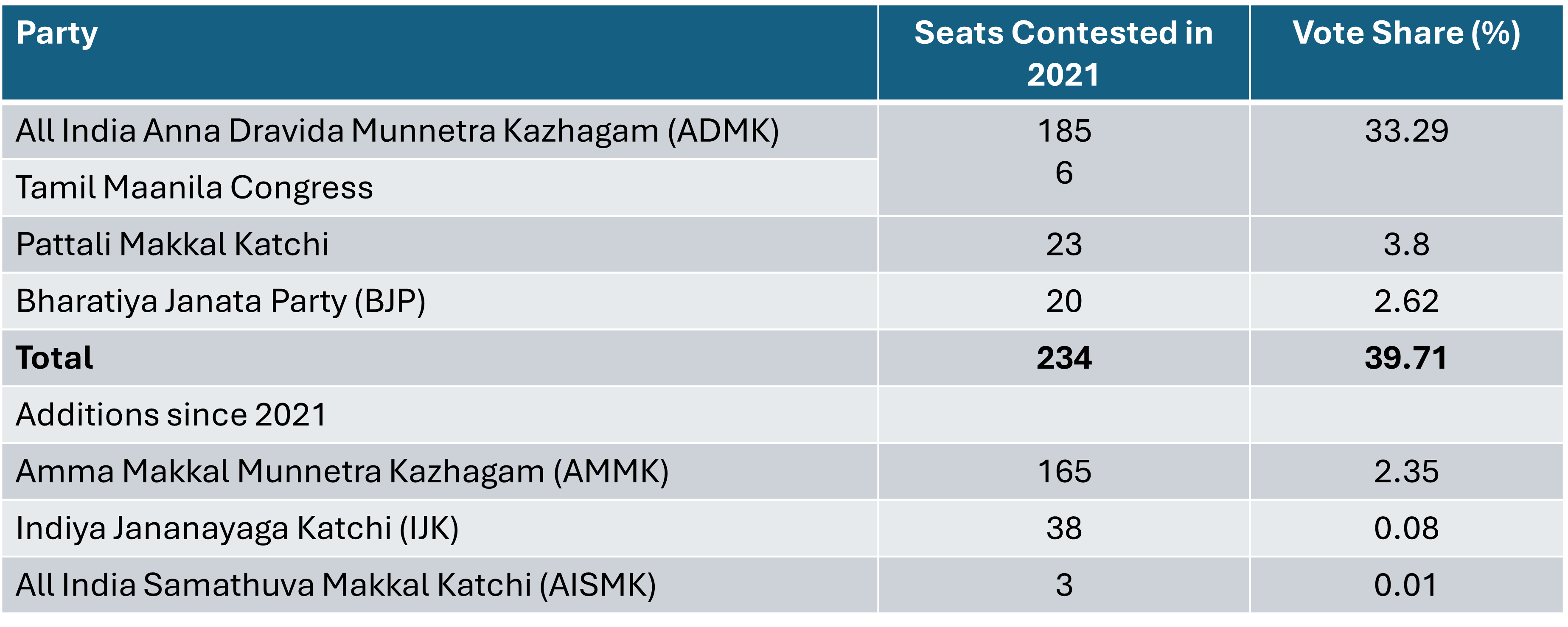
Note: Tamil Maanila Congress contested in 6 seats under ADMK symbol.
The BJP and the ADMK split after 2021 and contested the 2024 General Elections separately where the BJP witnessed a significant bump in vote share.
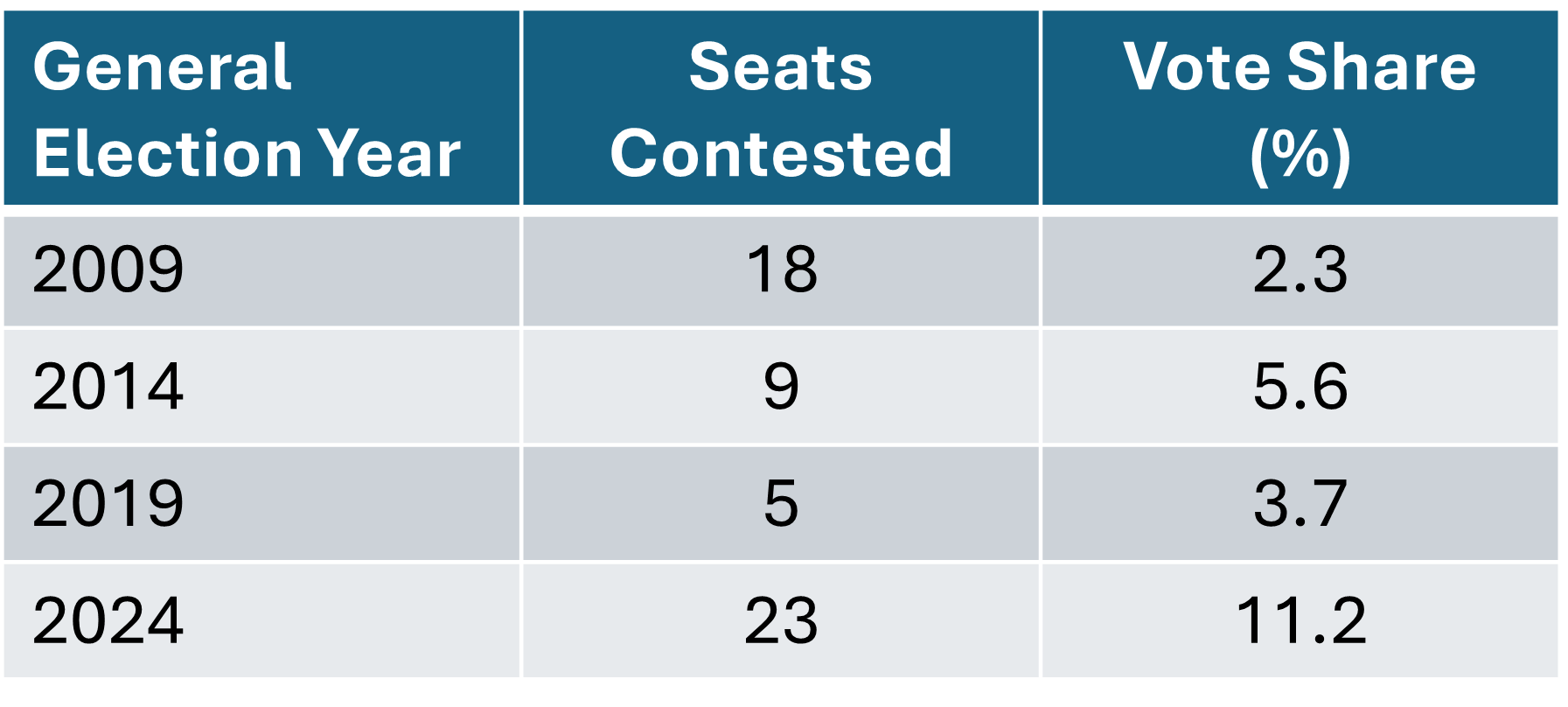
However, as CSDS post poll survey in 2024 indicates, the BJP did not force a major shift in voting patterns. Similar surveys in 2021 showed the presence of significant anti-BJP sentiment with 40% of voters (other than in Kongu Nadu, where only 23% said so) stating that “BJP is harmful for Tamil Nadu’s social fabric”. Therefore, 2026 will be a litmus test for BJP’s acceptability in Tamil Nadu.
Naam Tamizhar Katchi
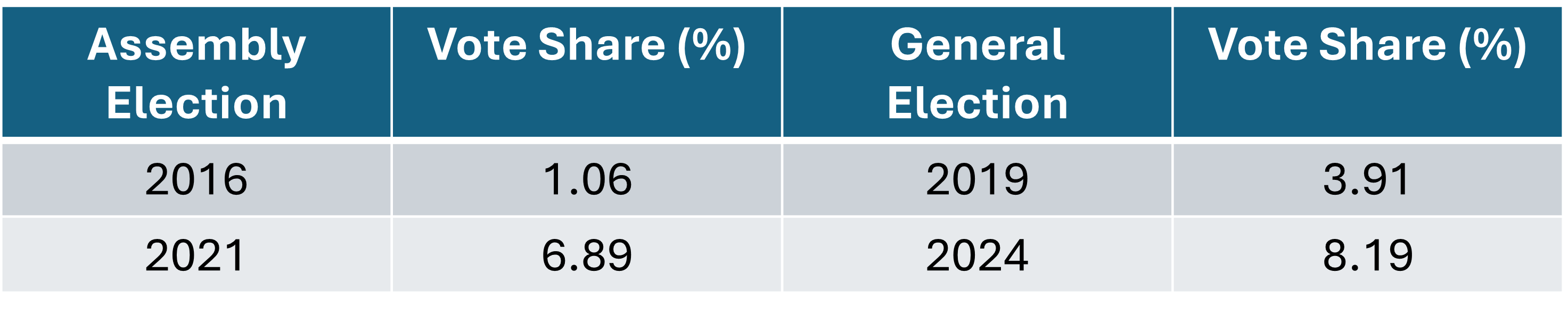
The Naam Tamizhar Katchi led by Seeman has till now not announced any tie up, and is expected to fight alone. It has consistently established a vote bank that is anti-establishment and against the two Dravidian parties. (see table below)
Tamizhaga Vettri Kazhagam
The TVK was formally founded in 2024 by actor politician Vijay, though his fan club contested local body polls in 2021 and won 115 out of the 169 seats it contested. Its notable successes were in 5 districts in Northern Tamil Nadu (Vanniar Belt) and pockets in 3 Southern districts (Pandya Nadu). Even though they won more than any third front parties like NTK or Kamal Hassan’s MNM and that too without any active campaigning by Vijay, it contested less than 1% of the 27000 posts at stake then.
TVK is contesting its first election in 2026. I present below a table detailing first time electoral performance of parties started in Tamil Nadu in South India by film stars as a framework to assess TVK’s potential impact.
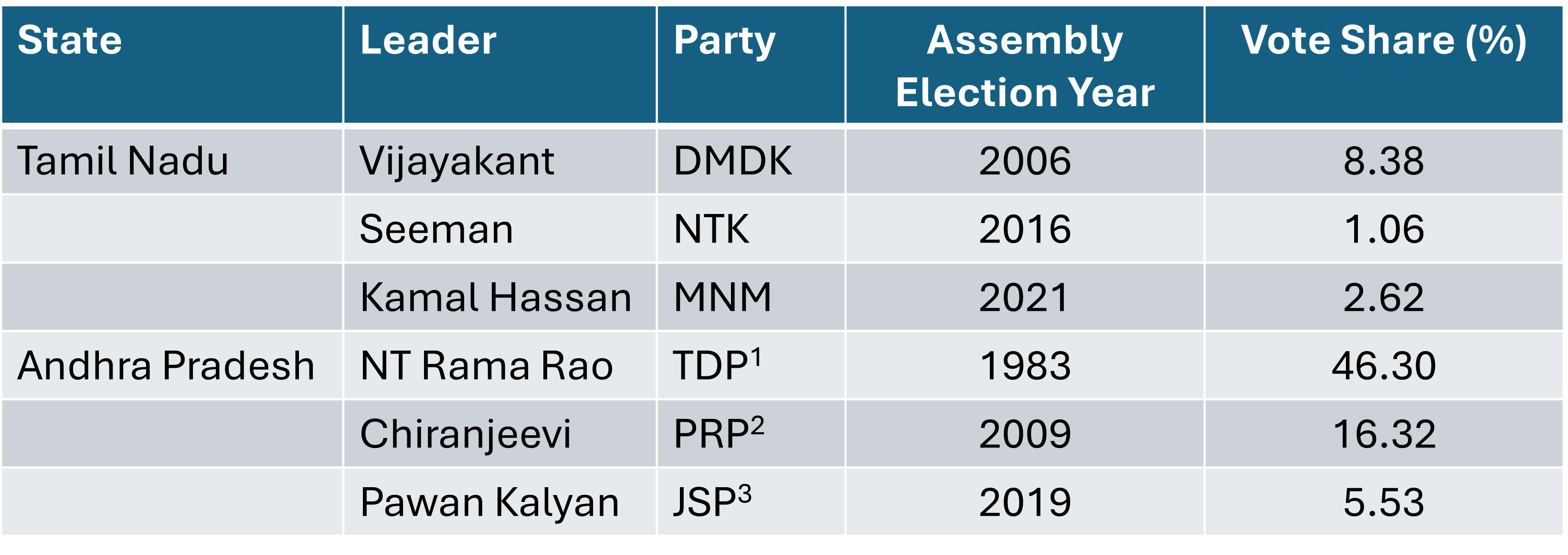
1- Telugu Desam Party, 2- Praja Rajyam Party, 3- Jana Sena Party
Note: I have deliberately not included MGR in this since he had been associated with the DMK for ~20 years before coming to power.
While TVK will be enthused by the precedent set by NT Rama Rao in 1983, the table above shows that no one first time entrant has captured power in the last 40 years or managed to create a new political front that has remained within striking distance of power. The next best scenario in table above is Chiranjeevi who benefited from the fact that he belongs to the largest caste in Andhra Pradesh (Kapu).
Big Picture
I use the graphic below to elaborate my argument.
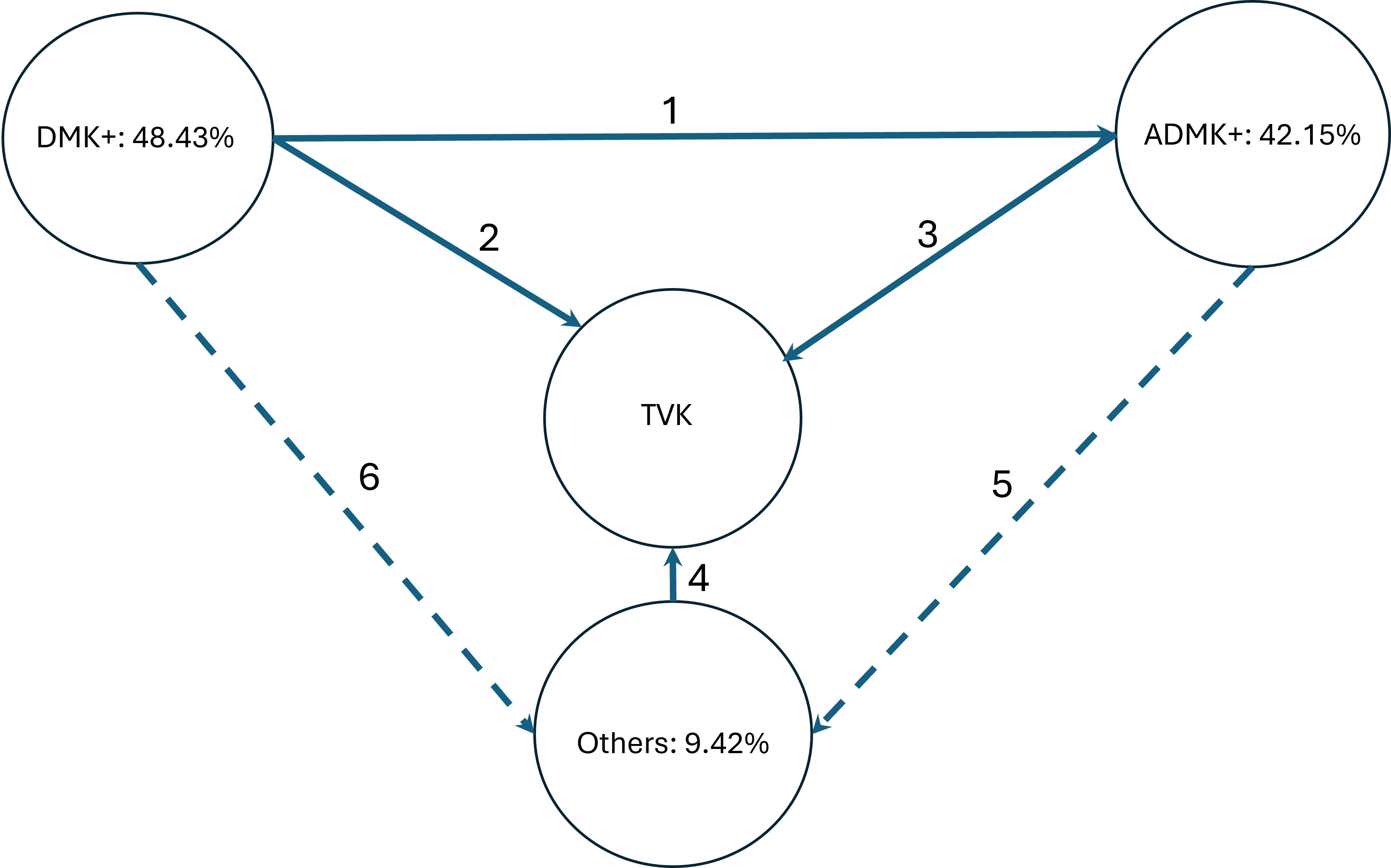
DMK and ADMK+ in fig. below include new additions since 2021 (assuming seamless transfer)
Since both major alliances together have garnered 90% + vote share in 2021, I have presumed minimum leakage from either alliance to ‘Others’ category (5 and 6 in picture below) since no new alternative other than NTK exists. I am therefore also implicitly assuming that there will be minimal impact due to rebel candidates contesting as independents.
There are 3 key questions arising from the above figure that hold the key to this election.
1. Level of anti-incumbency and its beneficiary
In figure above, 1+2 represents anti-incumbency loss of vote share. Anti-incumbency loss of vote share in the last 3 times that DMK has been in power has been 7.9% (1991), 15.1% (2001) and 5.3% (2011)- average of ~9.4%.
In the DMK’s entire electoral history, it has faced heavy anti-incumbency and has never retained power. This time, it has banked heavily on its women-centric welfare schemes like free bus rides, educational assistance, monthly payment of Rs. 1000 and distribution of free laptops to students to retain popularity. However, all these schemes have been in force for the last 5 years and have a mixed track record of implementation, and therefore I believe may not be enough to stave off anti-incumbency.
I project that the ADMK may receive only a minor share of this anti-incumbency vote (1-2%) and a majority will accrue to TVK, since swing voters like youth, urban voters and Scheduled Castes are likely to gravitate towards TVK. The key voter segments where Vijay is likely to make inroads are listed below:
Youth (18-25 age group): This segment constitutes ~12.4% of the population1. This vote segment has historically favored the DMK, and surveys has shown that NTK is popular with first time voters. I expect Vijay to make significant inroads in this segment, at the expense of NTK and DMK.
Scheduled Castes: Post poll surveys by CSDS have shown that Dalits have been swing voters in state elections. I expect that Dalits (especially in Northern districts) will move in significant numbers to the TVK given Vijay’s earlier success in local body polls in 2021 was largely in these districts. These voters have traditionally aligned with the DMK.
Women: Women in the non 18-25 segment who are attracted by Vijay’s appeal of a new political order may swing in some measure towards the TVK. ADMK has typically been the main beneficiary of the women vote. (covered subsequently)
Minority Votes: I expect Minority vote will largely consolidate behind the DMK led alliance even though Vijay is a Christian. This is because I believe that they view the DMK alliance as best placed to defeat any alliance that includes the BJP. There may be marginal shift of minority voters in urban areas and Northern Tamil Nadu towards TVK.
2. ADMK vote share loss towards TVK
Another key determinant of this election will be the quantum of votes that Vijay may capture from ADMK+ (3 in above picture). I estimate that this segment will comprise mostly of women in the non 18-25 year segment and some voters in the 25-30 age group. The women voter segment has come to become the most coveted one in Tamil Nadu politics, with the DMK’s welfare schemes and the ADMK’s counter-offers all aimed at women. Seeman’s NTK has a track record of providing tickets to a large proportion (~50%) of candidates, and I expect that there may be women votes that may accrue to Vijay from all other parties. I reckon that he may draw ~3% of the women vote from the ADMK. Let us try and now gauge the ability of TVK to harness votes.
3. Ability of TVK Organisation to harness votes
Vijay is estimated to have around 85,000 fan clubs across the state, with over a million registered members. This provides a large base of adoring fans to project his popularity. However, translating this support into votes needs a political organisation that can mobilise and harness votes, especially in Tamil Nadu where both ADMK and DMK are cadre-based parties.
Vijay’s public appearances have been few and far between till now and his messaging has been restricted to short set speeches. Further, there have been no interactions between the press and Vijay, and TVK has relied on social media to amplify its messaging and support. If Vijay’s campaign succeeds in getting a larger vote share than I am projecting, it may represent a paradigm change in how elections are fought and won. However, going by historical trends, I am sceptical on whether TVK’s political organisation can be built to a scale that matches the ADMK and DMK alliances within the 1-2 months left before the election. Further, based on current evidence, if Vijay does not undertake mass campaigning, his messaging may be impacted. A lot will therefore depend on TVK’s choice of candidates and their ability to channel Vijay’s popularity into votes.
My assessment is that Vijay will end up with a vote share of ~10-15%. I project that TVK will do well in Chennai city and reasonably so in other urban centres. Even though some recent surveys in Tamil Nadu have projected 30%+ popularity for TVK, I believe that this will not translate to votes because:
TVK’s lack of political organisation
Vijay’s reluctance to undertake mass physical campaigning.
Lack of alliances
Voter reluctance to back a non-winning party
This arithmetic and the distribution as per what I have highlighted above turns the contests into a virtual dead heat, with both alliances hovering around the 40% mark (see graphic below). This explains the DMK’s continued pursuit of alliance partners like the DMDK (0.43% vote share in 2021), and leaders like former CM O.Paneerselvam, who joined the DMK today.

Projections
I have assumed the following in making my projections.
The leakage of votes because of individual leaders like O. Paneerselvam, Dr. Ramadoss and N. Sasikala from ADMK+ is unlikely to be significant since their political machinery is largely in the control of their earlier compatriots who are now in the ADMK alliance.
Despite coalition party pressures within the DMK alliance, seat sharing and alliance chemistry will be repaired before the election.
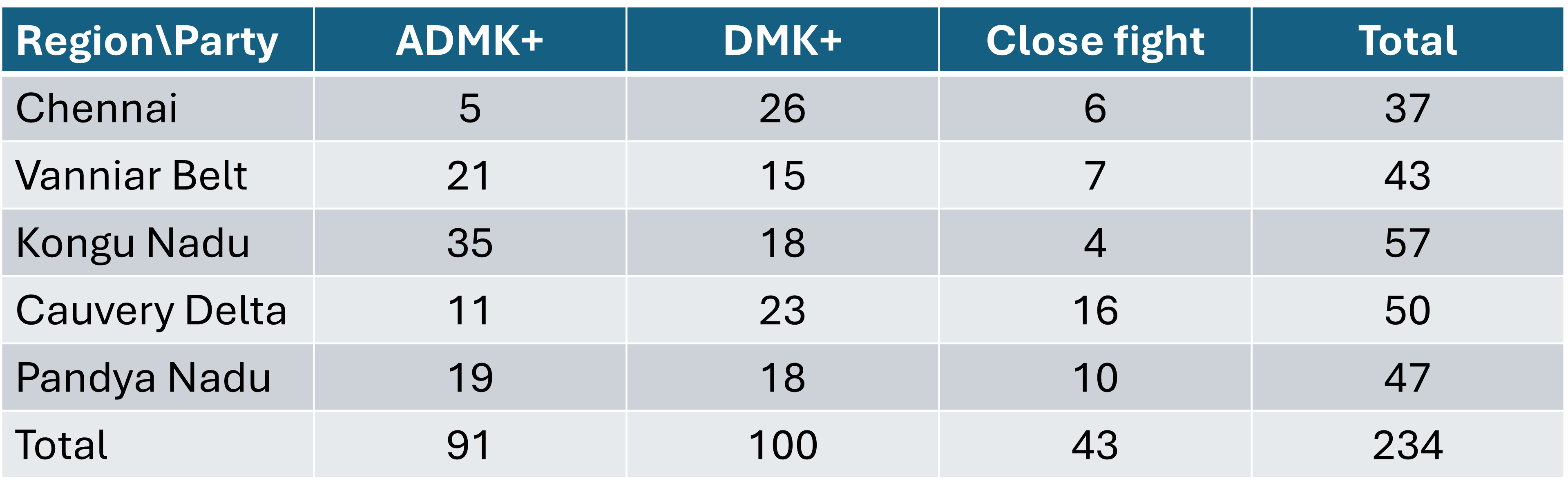
I project that the race in Tamil Nadu will be a neck and neck one that will be decided on the basis of the campaign, candidate selection and manifesto commitments. The Cauvery Delta region (and Pandya Nadu to a lesser extent) will be most significant in deciding the eventual winner.
The following factors will be critical in determining the results of the election.
Alliance Chemistry
The ADMK alliance fought the last assembly elections with the BJP, following which they parted ways and contested the 2024 General Elections separately. They have since re-united. Similarly, the AMMK of Mr. TTV Dhinakaran fought the 2021 elections separately and the 2024 General Elections in alliance with the BJP. The extent to which these parties are able to evolve a ground chemistry in favor of the alliance will be critical.
Similarly, the DMK alliance is likely to witness sharp seat sharing negotiations and has also seen a tense stand-off between the INC and DMK. The extent to which they are able to iron out these differences and work cohesively will be critical.
Localisation of the Election
The DMK has sought to portray the upcoming fight as one between Delhi and the Tamil Nadu people and sought to project itself as the preserver of Tamil pride. This is an effective strategy to both deflect attention from local anti-incumbency and also to focus on building anti-BJP sentiment which has been used effectively before by both DMK and ADMK. The ADMK has been making a slew of campaign commitments including doubling the monthly payments to women from Rs. 1000 to Rs. 2000, a one-time payment of Rs. 10,000 to every family in Tamil Nadu and benefits for targeted groups like farmers, fishermen, religious minorities , and has made concerted efforts to keep the narrative local. The ability of the NDA to localise its campaign and harness anti-incumbency will be critical for its success.
Source: 2011 Census