
Bihar Election Analysis
Part 1: Sanghe Shakti Kaliyuge

Background
I restart my election coverage with the upcoming Bihar polls in Oct/Nov 2025, that has several implications:
Bihar will be the first large state election in the Hindi heartland after the 2024 general elections and will give reveal the popularity of the ruling dispensation
Will provide headwinds for later elections in West Bengal and Uttar Pradesh
Will show whether Bihar CM Nitish Kumar can overcome nearly 20 years of anti-incumbency
Will the caste neutral pro-development plank of the newly formed Jan Suraaj party achieve success?
The heading borrows the slogan of the Triveni Samaj that was formed in 1934 with the objective of political empowerment of three backward castes (Kurmis, Koeris and Yadavs). This was a first attempt at bringing numerically superior but socially backward castes into Bihar's power structure. The heading also implies that in Kaliyuga, one’s strength depends on his Sangha (caste/organisation).
Geography & History
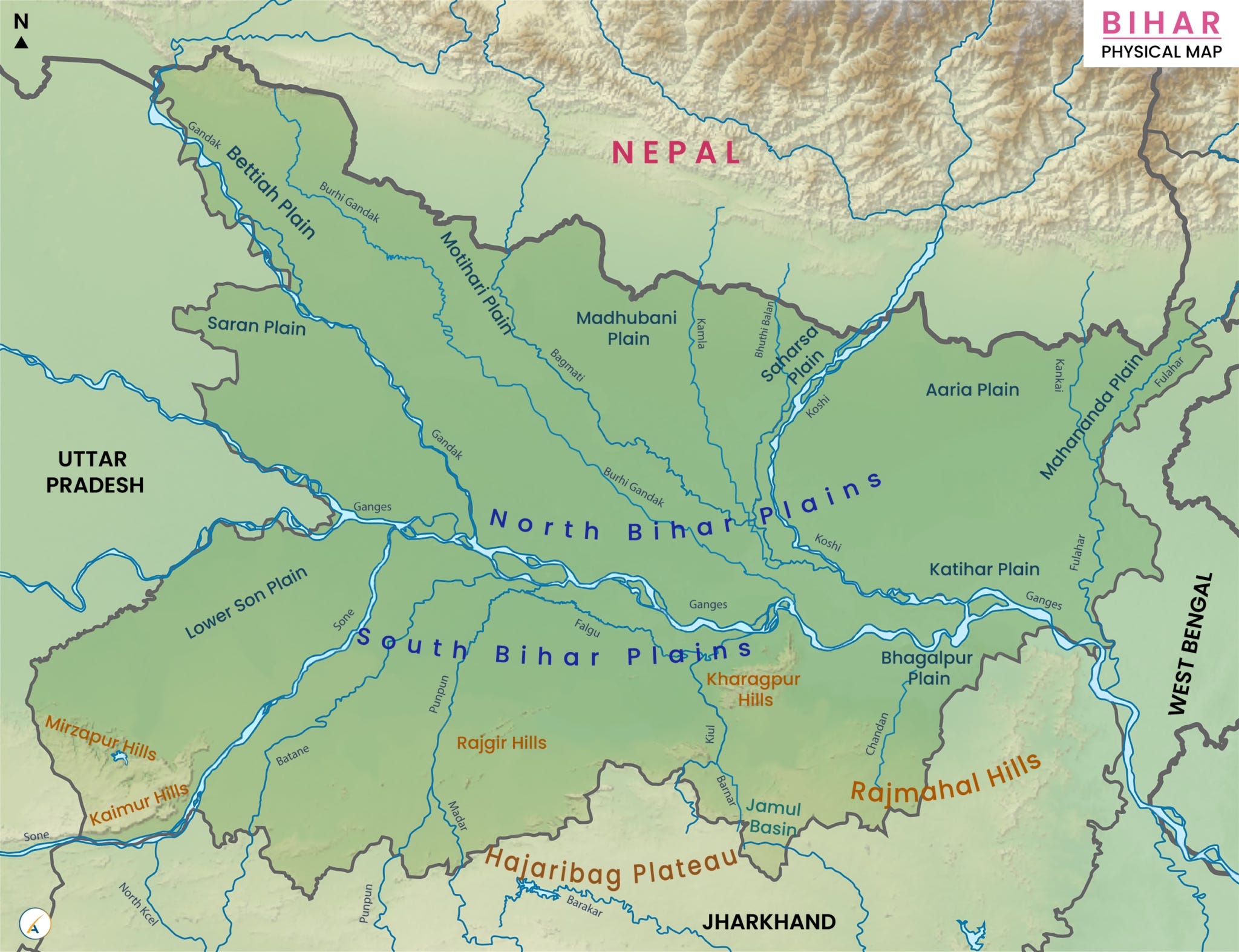
Geography dictates most facets of Bihar’s economy, politics and social structure. The Ganges almost bisects the state (see map above). Since Bihar is a flat state drained by many rivers and vast alluvial plains, control over agricultural land has remained at the core of its power structure.
The northern part of Bihar (bordered by the Ganges, the Gandak and Kosi on South, West and East) was home to the Videha kingdom that was overthrown by the republican Licchavi tribes in 7th century BCE. Mithila (the land of Janaka) was a well established city even in Videha times, and Maithili is the most prominent language of these parts even today. Bihar's reputation as the cradle of Indian democracy can be traced to the Licchavi Ganasangha, a highly participative grassroots democracy.
South Bihar was home to the Magadha Kingdom that was bounded on the North, West and East by the Ganges, Son and Kosi rivers). South Eastern Bihar was home to the Anga kingdom, bounded by the Kosi and Ganges to the West and North respectively (Anga was the kingdom gifted by Duryodhana to Karna). Angika is the language spoken widely in South Eastern Bihar even today.
Another key ruler of the region was Raja Bhoja (1010-1055 CE) , who created the city of Bhojpur on the banks of a huge man-made dam. His kingdom was bounded by the rivers Son and Gandak in the East and to this day, the Bhojpuri language is most prominent in this region. Sher Shah Suri (who ruled Bihar, Bengal and later Delhi in 16th century CE) established the first Afghan kingdom in Sasaram (Western Bihar).
Political Regions
I have divided Bihar into political regions (see below) based on language, and religion to a lesser extent.
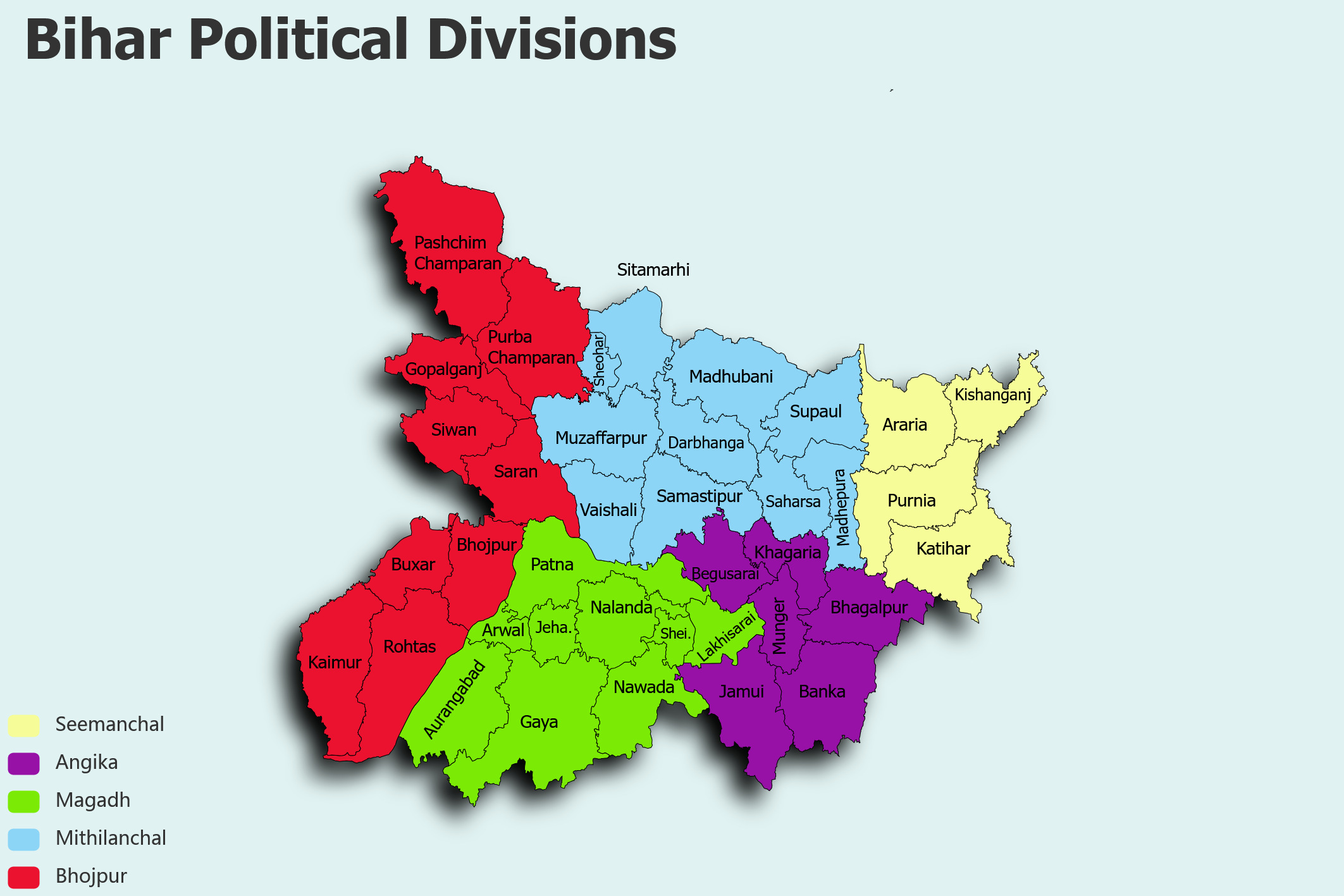
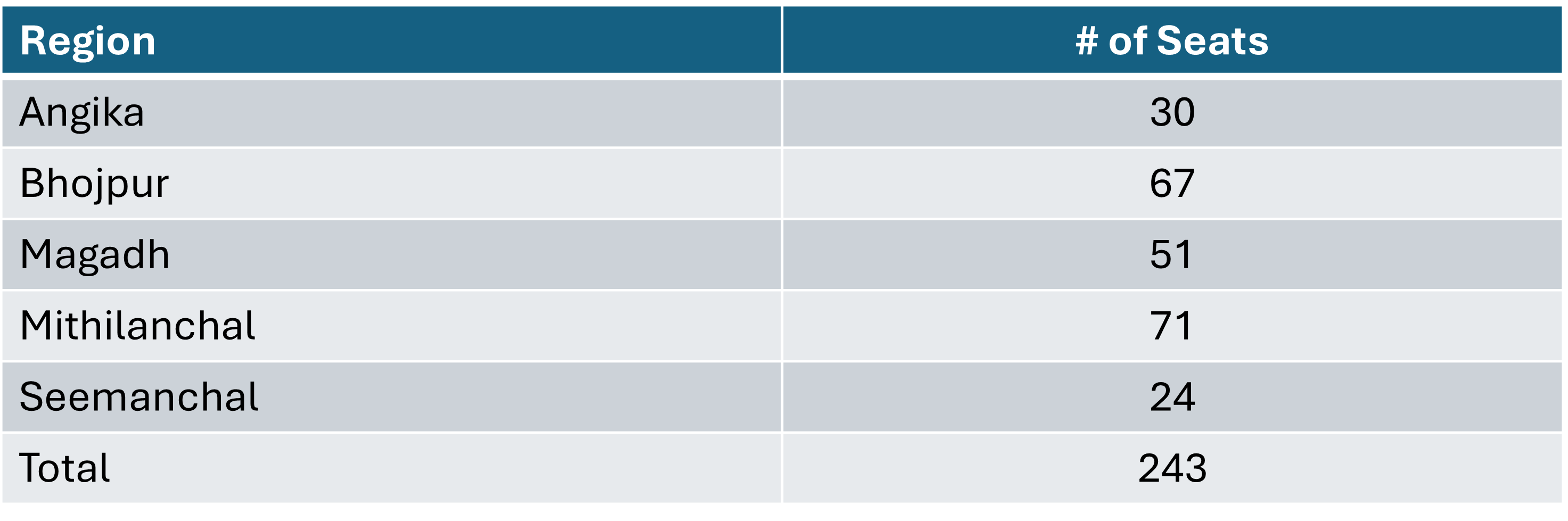
Angika, Magadh, Mithalanchal and Bhojpur are dominated by their respective languages. I have analysed Seemanchal separately since it is Muslim dominated, as we will see. Regional contribution to the Bihar Assembly is shown below. Bhojpur, Mithilanchal and Magadh are the 3 most politically significant regions.
Let us now turn to Bihar’s demographics.
Religious Demography
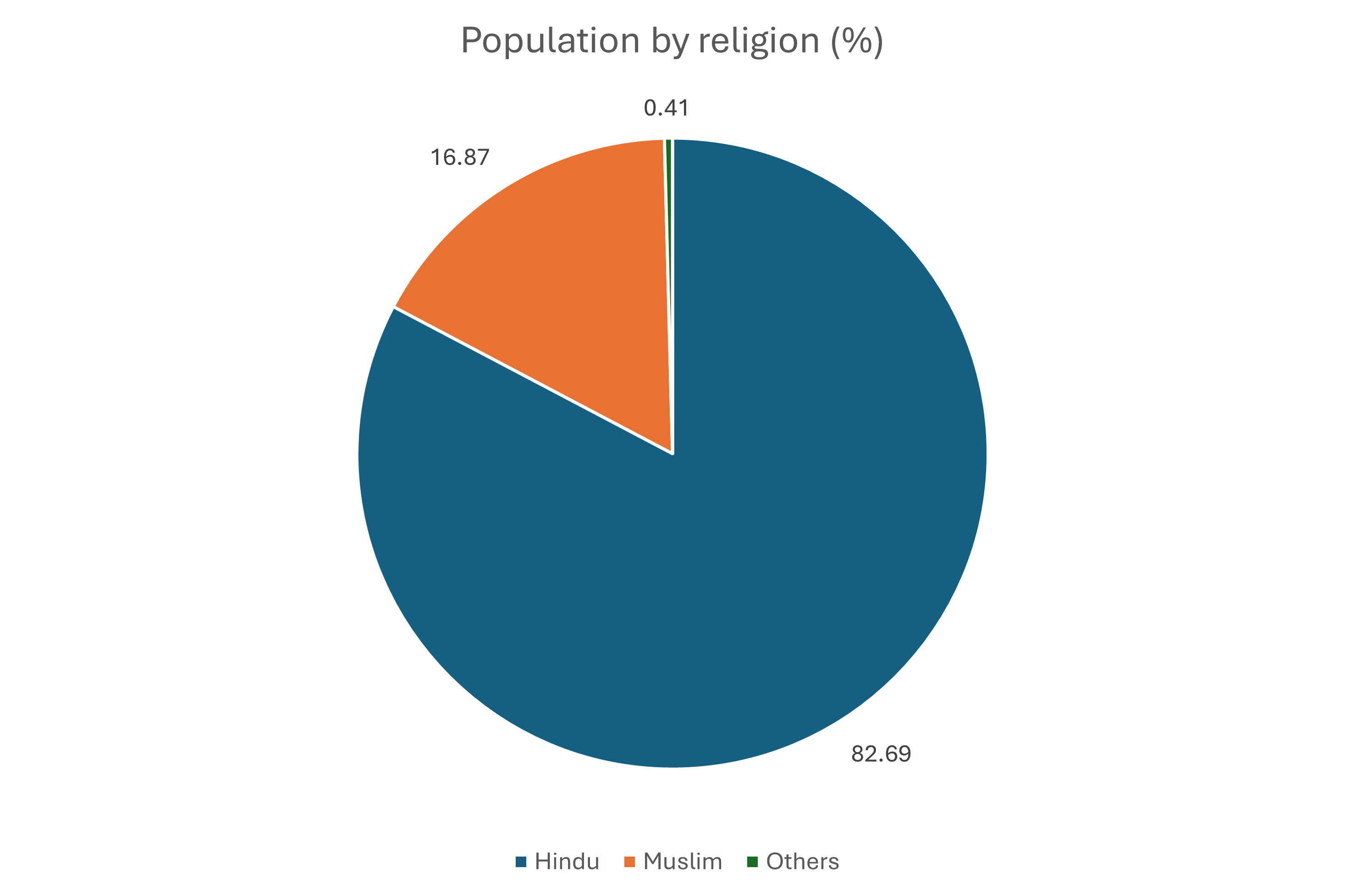
Bihar is primarily Hindu, as per chart below. (Source: 2011 Census)
The Muslim population is high in all 4 districts of Seemanchal region in North East Bihar. (see table below)
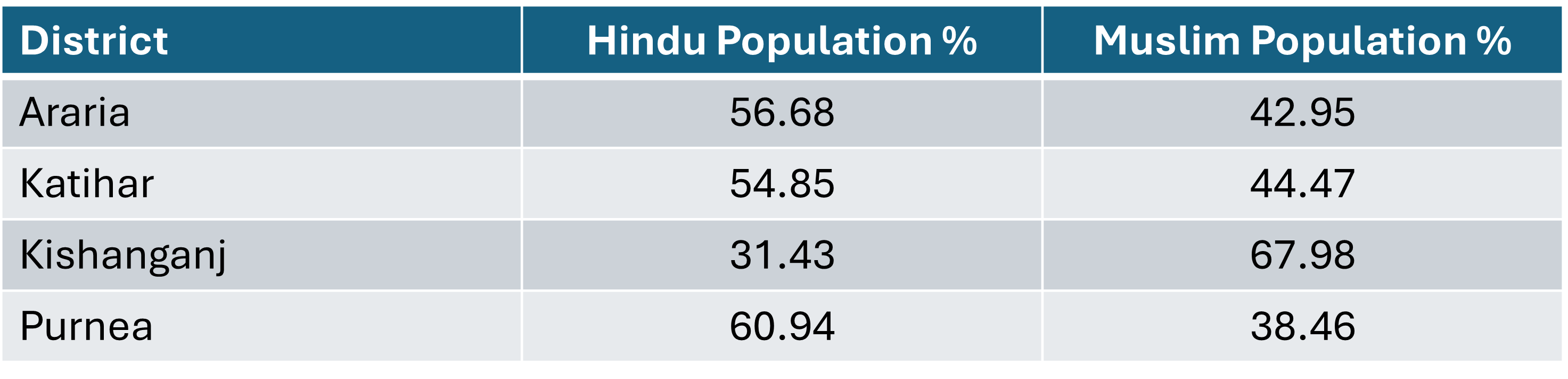
Further, the Muslim population is higher in North Bihar (north of Ganges) by almost 7% compared to South Bihar, even after Seemanchal is excluded.
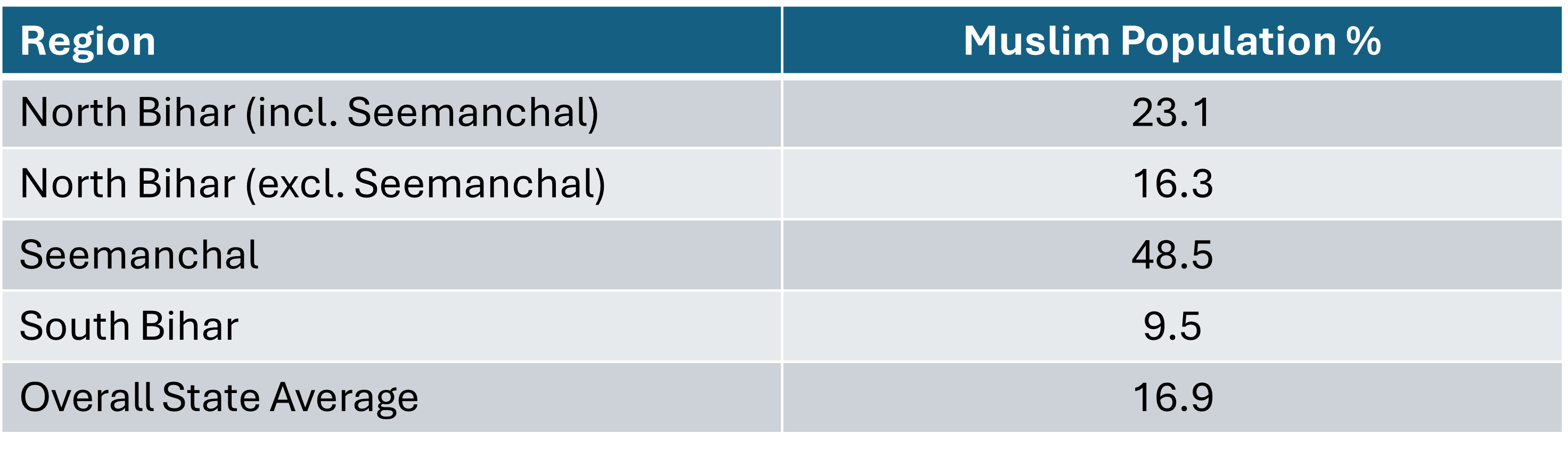
Muslim constitute more than 30% of the population in about 10% of the seats in Bihar and influence electoral outcomes here.
Caste Demographics
Due to the caste survey conducted by the Bihar Government in 2022, more granular data on castes is available than in other states. Survey highlights are as follows:
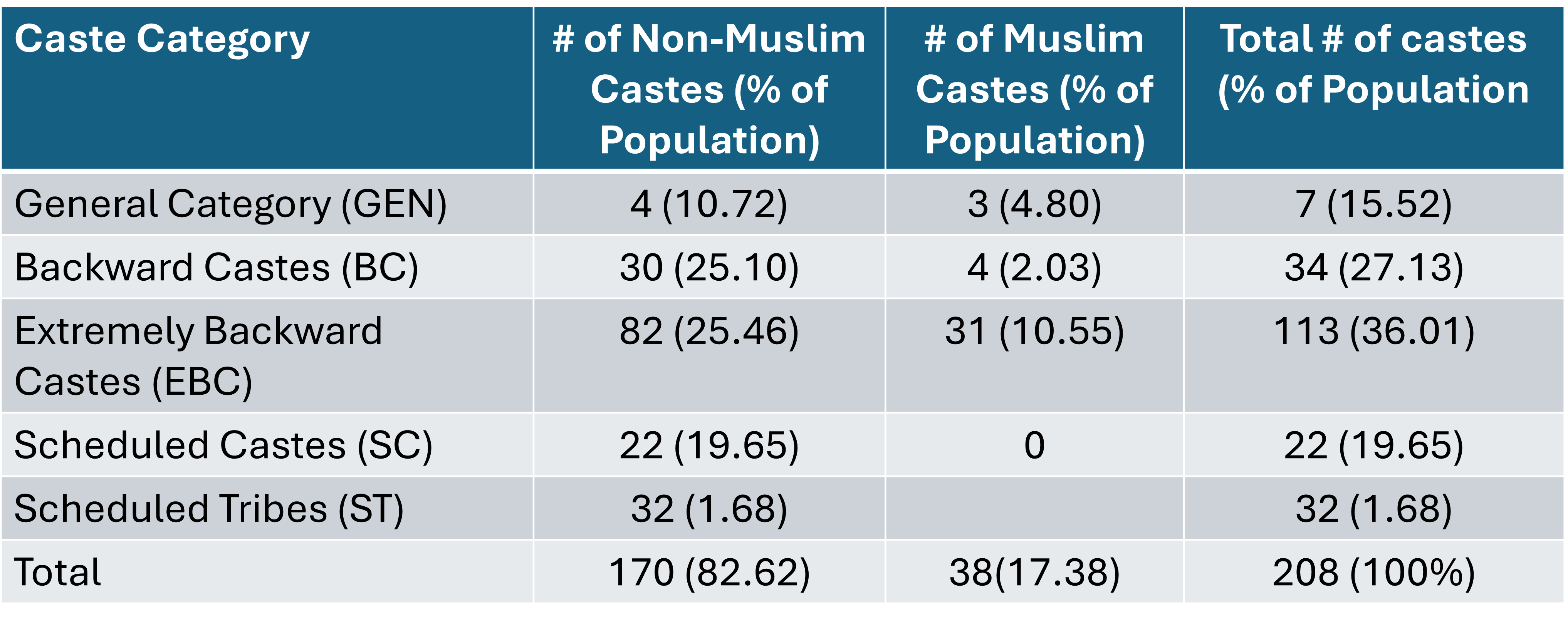
Note: Non-Muslim above includes Hindus, Christians
63% of the population is either BC or EBC, thereby highlighting their political salience. Let us now examine each of these groups below.
Scheduled Castes
As per Census 2011 data, Scheduled Castes constitute 15.9% of Bihar’s population (19.65% as per 2022 caste survey). The 3 dominant castes among the 22 SCs in Bihar are Dusadh (Paswan), Chamar (traditionally, their occupation linked to leather) and Musahar (literally means rat eater, but in more recent times agricultural labourers). A sub-categorisation of SCs is below:
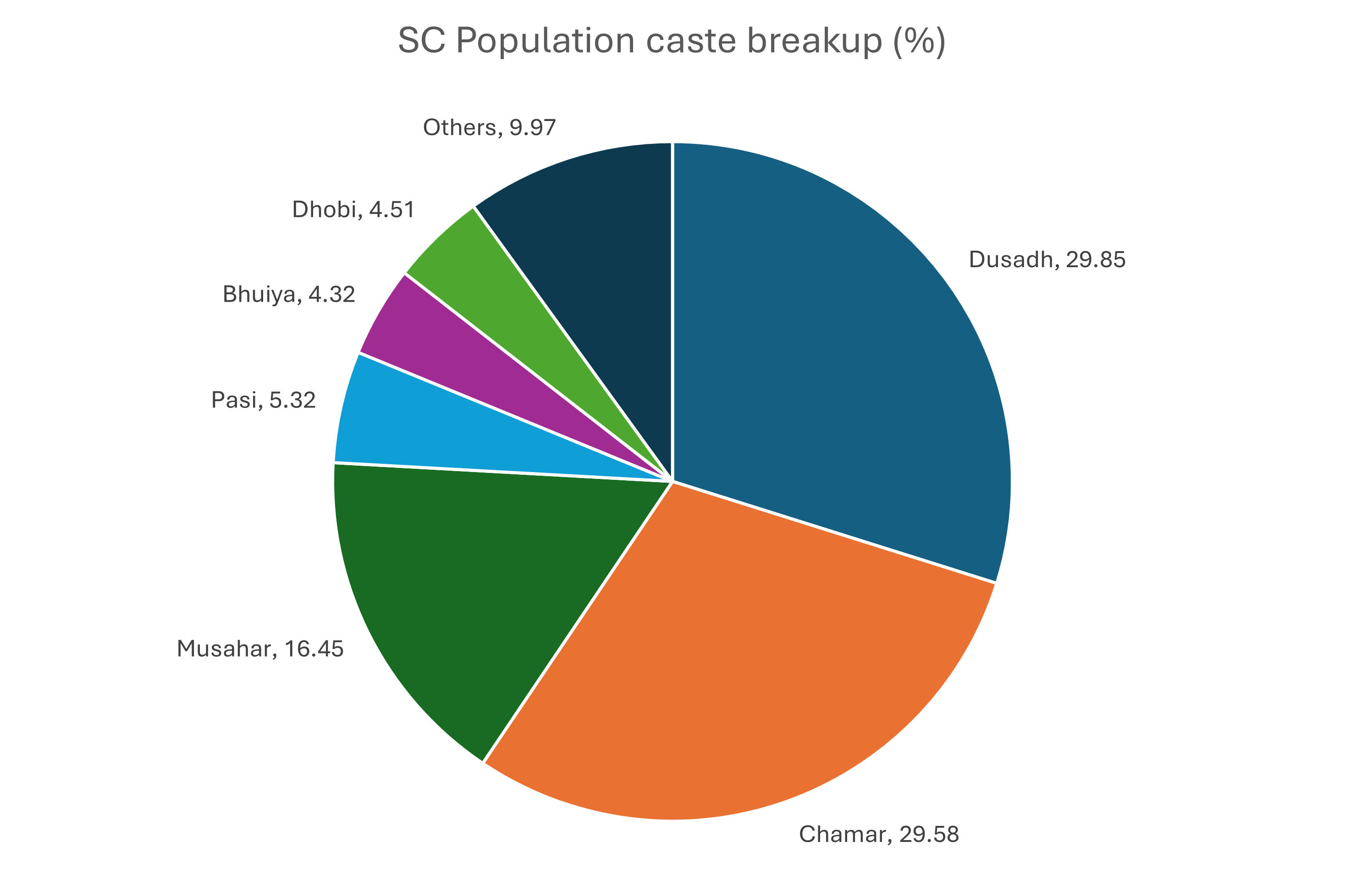
Smaller castes are either spread throughout the state (e.g. Dhobi, Dom1) or concentrated in specific regions (Pasi2 in Magadh region, Bhuiya3 in Gaya and surrounding districts, Hari4 caste in Katihar, Rajwar caste5 in Nawada). Other scheduled castes in Bihar are 1% or less of the total SC population and therefore not politically relevant. The core support base of 2 state parties viz. the Lok Janshakti Party (LJP) and Hindustan Awaam Morcha (Secular)/HAMS comprise Paswan and Musahars respectively. The Bahujan Samaj Party led by Mayawati has pockets of strength in Bhojpur and Chamars have been its traditional support base.
Scheduled Tribes
Scheduled tribes (STs) account for around 1.3% of Bihar’s population as per 2011 census (1.68% as per 2022 caste survey) and are overall electorally insignificant. Pockets of tribal influence are found in West Champaran in North Western border of Bihar (6% ST population) that is home to the Tharu tribe. (this region is where Sage Valmiki is believed to have lived) Most other tribes live close to the Eastern border of Bihar (adjacent to West Bengal and Jharkhand). The tribes in this Eastern belt are the Oraon, Santhal tribes. Small pockets of Gond prominence (Siwan district, 3% of total population) and Kharwa tribe in Kaimur district (3% of population) are also seen.
General Castes
The seven general castes in Bihar and their share of total population is presented in table below:
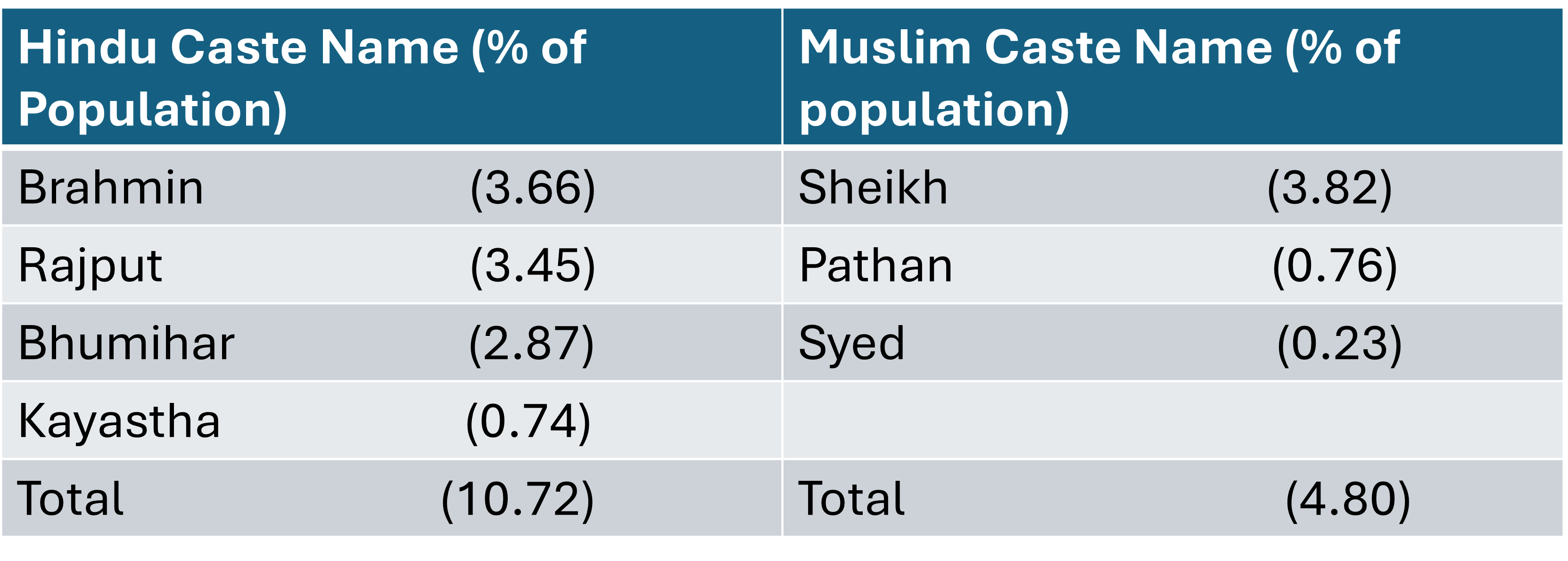
Brahmins are the most numerically prominent Hindu general caste. They are numerically salient in pockets of Darbhanga, Madhubani and Gopalganj, although their hold over electoral politics has been declining. Rajputs are numerically prominent in pockets of Saran and Aurangabad (which is sometimes called mini-Chittorgarh). Bhumihars are a caste found primarily in Bihar. This traditionally land owning class, traces its ancestry to Sage Parashurama and practise the Ayachak tradition of Brahmins (Brahmins who refuse to beg). They are numerically salient in parts of Begusarai and eastern Bihar, and their electoral prowess extend beyond their numbers on account of their land holdings. Kayasthas trace their origin to Chitragupta (Yama’s scribe) and were historically linked associated with their positions of power in royal courts on account of their knowledge and language prowess. They are electorally significant in pockets of Patna district.
Sheikhs (dominant Muslim general caste) trace their ancestry to Arabs or denote upper Hindu castes who converted to Islam. Syeds represent the pinnacle of the Muslim caste hierarchy and trace their ancestry directly to the Prophet Muhammed through his daughter. The Pathan caste traces its origin to Afghan heritage and came about after invasions led to the establishment of the Delhi sultanate.
Backward Castes
Even though there are 34 castes listed under this category (4 Muslim and 30 non-Muslim), only 5 castes have a population that exceed 1% of the state population. These are as follows:
Yadavs constitute 14.27% of the state’s population and are by far its most numerically dominant caste. This caste enjoyed political hegemony between 1990-2005 because of Lalu Prasad Yadav’s leadership in the state. Yadavs are however not a political monolith and surveys have shown that only 60-70% of Yadavs vote for the RJD( Lalu Yadav’s party).
The Kushwaha (Koeri) caste traces its origin to Kush, Lord Rama’s son and constitutes 4.2% of Bihar’s population. This caste determines electoral outcome in about 15% of Bihar’s seats. The Rashtriya Lok Samata Party founded by Upendra Kushwaha has tried to consolidate this caste into an electoral force and has had limited success especially in the Bhojpur region. However, prominent Kushwaha leaders are found across parties.
Kurmis are about 2.9% of Bihar’s population, and see themselves as descendants of Lord Rama. Chief Minister Nitish Kumar belongs to this caste, that is electorally powerful in Nalanda and surrounding areas.
The Bania (trader community) constitutes around 2.3% of Bihar’s population and is relatively uniformly spread throughout the state.
Surjapuri is the only numerically significant Muslim backward caste (1.9% of state population). They are found almost exclusively in Seemanchal and are linked with the Rajbanshi caste in neighbouring Bengal.
Extremely Backward Castes
There are about 115 castes in this category. Most of these are numerically insignificant to individually affect electoral outcomes. However, collectively, they are the most numerous. Nitish Kumar’s electoral success has been widely attributed to his ability in creating a sticky vote bank among EBCs. The top 5 castes (by share of population) are as follows:
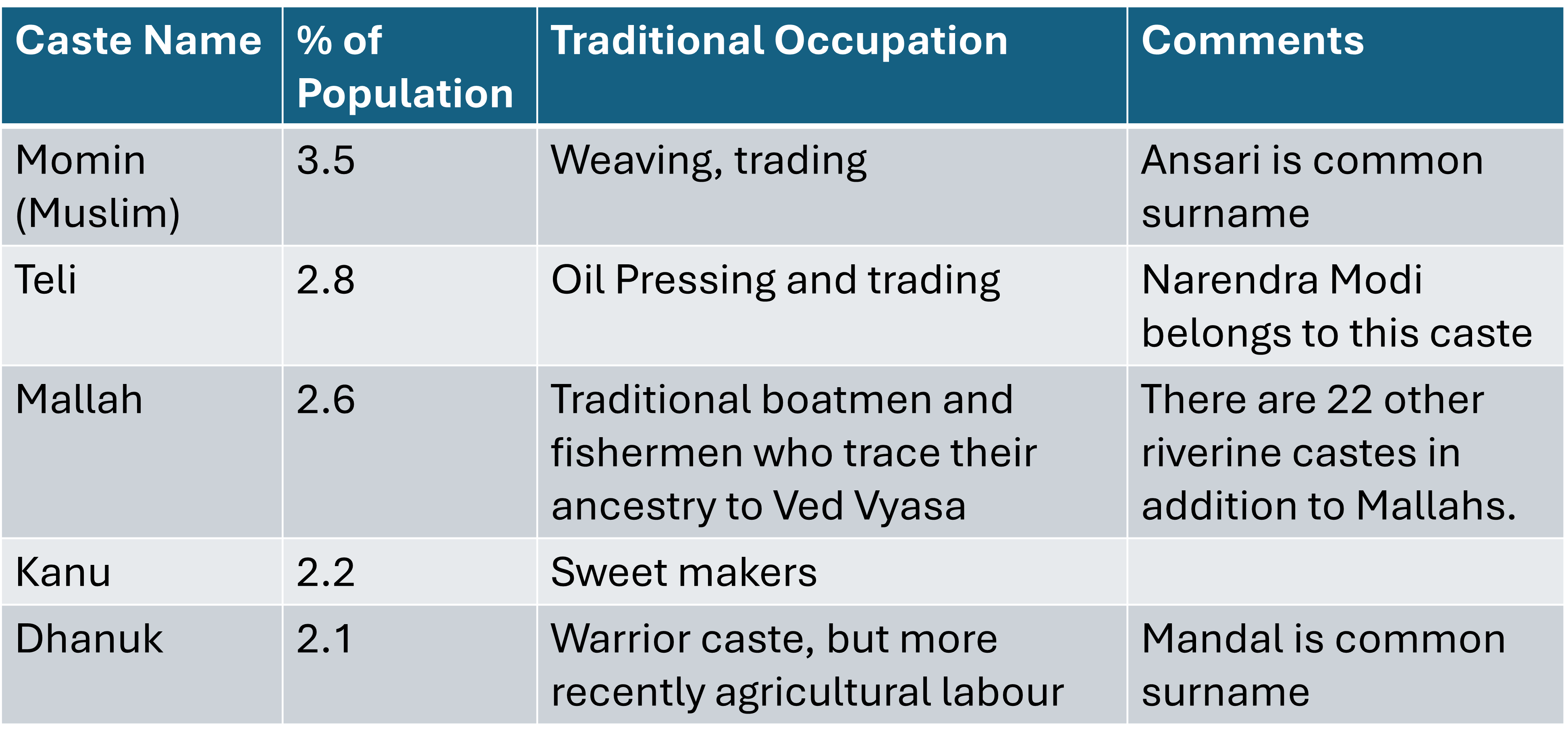
The Vikassheel Insaan Party led by Mukesh Sahni in 2018 is an attempt by him to consolidate all 22 riverine castes into a vote bank. There are no other caste specific EBC parties in Bihar.
We have seen how Bihar’s history and geography shapes its religious and caste demographics and political regions. Next time, I will contextualise Bihar’s electoral history, its parties and leaders and unique aspects of its political structure.
This caste has been traditionally linked with cremation, burial activities
This caste has traditionally been linked with toddy tapping activity
This caste has been traditionally agricultural and believe that they are descendants of Bhoomi Devi (Mother Earth)
A sub-caste of Dom caste
Believed to have arisen from the Bhuiya caste. Employed primarily in agriculture
Thank you. Lovely analysis. Bihar needs a figure like yogi who can steer the state to growth, control the anarchic forces and make population productive.